Ways to tie a scarf: square, long and skinny scarves
A scarf is the cheapest way to change an outfit. The same coat looks different with a chunky wool wrap, a printed silk square or a narrow strip of colour at the neck. The trouble is that most people own several scarves and tie all of them the same way. Learning a handful of knots, and knowing which suits which scarf, makes them far more useful.
Know your scarf
The fabric and the shape decide which knots work.
| Type | Typical fabrics | Best for |
|---|---|---|
| Long winter scarf | Wool, cashmere, acrylic knits | Warmth, chunky knots and wraps |
| Long lightweight scarf | Cotton, modal, viscose, linen | Loose drapes, all-season layering |
| Large square | Silk, cotton, wool blends | Triangles, bandanas, shoulder wraps |
| Small square | Silk, satin, polyester twill | Neck knots, hair, bag handles |
| Skinny scarf | Silk, jersey | Ties, bows, belts |
A rule of thumb: thick fabrics need simple knots, because the volume does the work. Fine, slippery silks hold intricate knots better but come undone if the knot is too loose.
Long scarves
The simple drape
Hang the scarf around your neck with both ends falling evenly down the front. It is the easiest look of all and works well with an open coat or blazer, as it creates a long vertical line.
The once-around
Wrap the scarf around your neck once, leaving both ends hanging at the front. Adjust one end to be slightly longer for a more relaxed look. This is warmer than the drape and suits medium-weight scarves.
The Parisian knot
- Fold the scarf in half lengthways so you have a loop at one end.
- Place it around your neck.
- Pull both loose ends through the loop and tighten gently.
Neat and secure, it is the classic choice for a wool scarf under a coat collar.
The reverse Parisian
Start as above, but after passing the ends through the loop, twist the loop once and pass one end back through it. The result is a woven, chunkier knot that sits well on plain jumpers.
The infinity wrap
Wrap the scarf around your neck twice, then tie the two ends together in a small knot and tuck it under the loops. It creates the look of a snood without the bulk.
Square scarves
Square scarves start with one of two folds:
- Triangle: fold one corner to the opposite corner.
- Band: fold into a triangle, then fold the long edge towards the point a few times until you have a strip.
The cowboy triangle
Fold into a triangle and place the point at the front, with the ends wrapped around the back of the neck and tied at the front or the side. It works with open-neck shirts and denim; see our ideas for wearing one denim shirt five ways.
The neckerchief
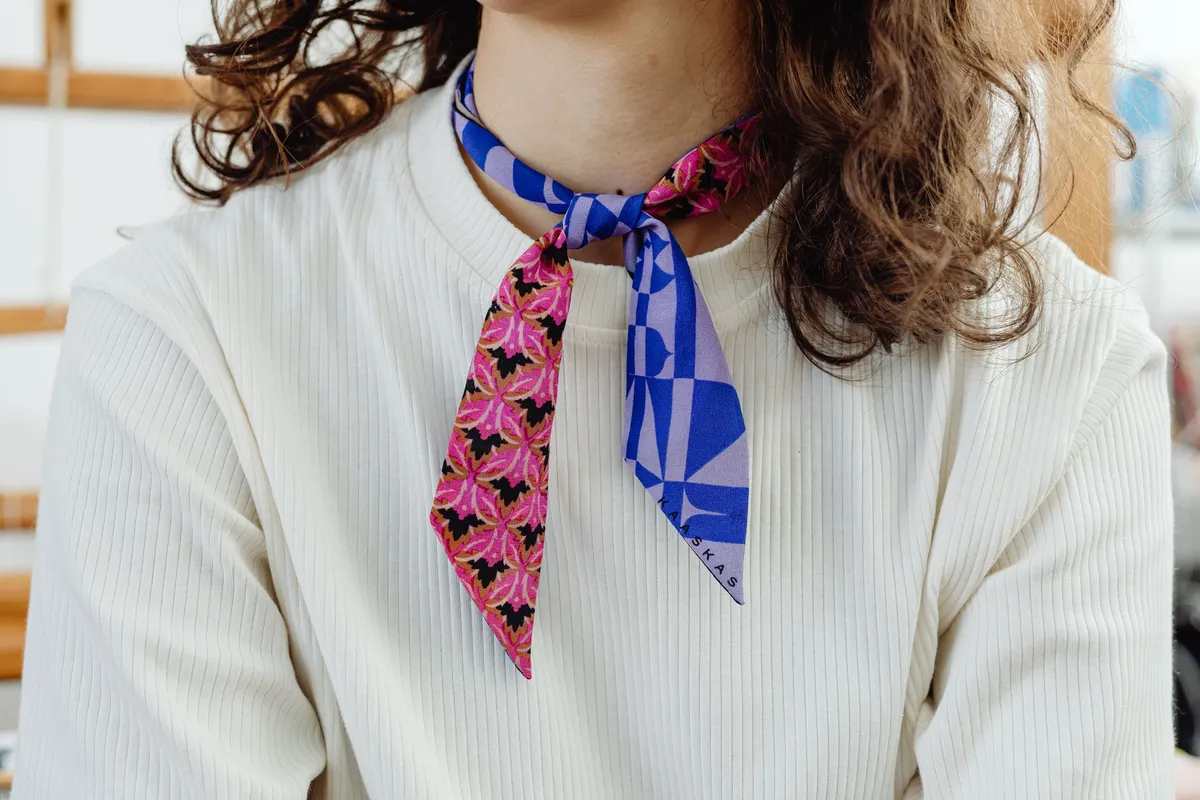
Fold a small square into a narrow band, wrap it once around the neck and tie a small double knot at the side. Push the knot slightly off-centre. It instantly adds a point of colour to a plain T-shirt or a trench coat.
The shoulder wrap
A large square folded into a triangle can be worn over the shoulders, with the ends tied loosely at the front or fastened with a brooch. It is a light extra layer for summer evenings or air-conditioned offices.
Skinny scarves
A narrow scarf is almost like a ribbon. Tie it in a loose bow at the collar of a blouse, knot it like a tie under a shirt collar, or let it hang long with a single knot at the base of the throat. Because it is so small, it can be bold in colour or print without overwhelming an outfit.
Beyond the neck
Scarves do not have to stay around your neck:
- On a bag: tie a small square around the handle of a leather bag. Our guide to choosing a leather bag covers which shapes take this well.
- In the hair: as a headband, around a ponytail or woven through a braid.
- As a belt: thread a long silk scarf or skinny scarf through the belt loops of jeans.
- On the wrist: wrap a small scarf several times and tie it like a cuff.
Matching the scarf to the outfit
- Pick up one colour from your coat, bag or shoes and let the scarf repeat it.
- With a busy print, keep the rest of the outfit plain. A monochrome wardrobe is the perfect background for patterned silk.
- In autumn and winter, match the weight of the scarf to the coat: chunky with chunky, fine with tailored. Our guide to autumn layering has more ideas.
Caring for scarves
Silk scarves are best hand washed in cool water with a gentle detergent, or dry cleaned if the label requires it. Roll them in a towel to remove water and dry flat, out of direct sunlight. Wool scarves should be aired often and washed rarely. Store scarves folded in a drawer or rolled, rather than knotted on a hook, where they stretch and crease.
This article may contain partner links. They never influence what we write.